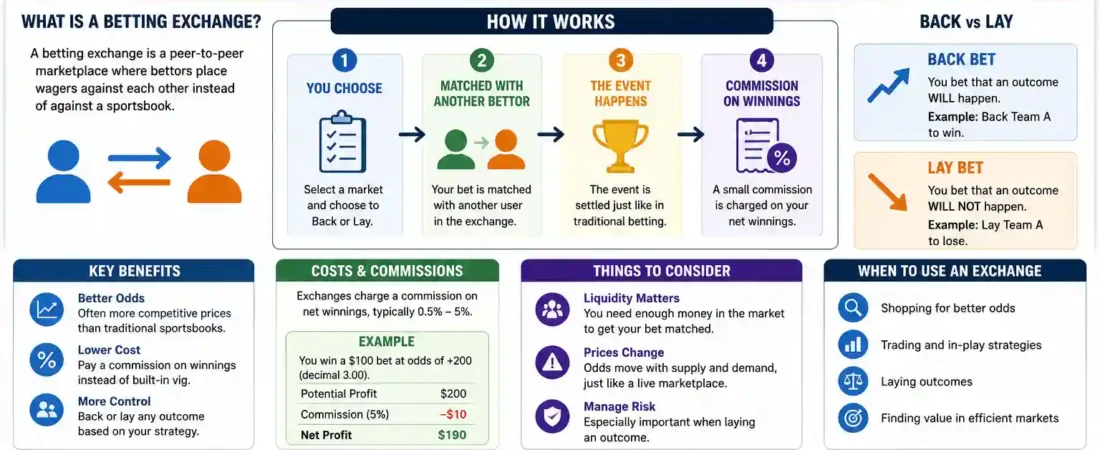
A betting exchange is an online marketplace where people can bet against one another rather than placing every wager directly against a traditional bookmaker. The exchange provides the platform that brings opposing bets together, matches them, and settles the market according to its rules.
For someone familiar with conventional sports betting, the biggest difference is the ability to back an outcome or lay it. This creates more flexibility in how a bet can be placed and managed. However, exchange betting also introduces concepts such as liability, liquidity, unmatched bets, and commission that beginners need to understand.
What Is a Betting Exchange?
A betting exchange works somewhat like a marketplace. One participant wants to bet that an outcome will happen, while another is willing to take the opposite side.
For example, imagine a football match where one user wants to back Team A to win. Another user may believe Team A will not win and offer a lay bet. If the price and amount are compatible, the exchange matches the two positions.
The platform generally does not need to take the opposite side of the wager itself. Instead, it facilitates the transaction between users and may charge commission according to its pricing structure.
This model is different from a conventional bookmaker, where the bookmaker normally publishes the available odds and accepts the customer’s bet.
How Does Exchange Betting Work?
The process can be understood through four basic stages.
1. Choose a Market
First, a user selects an available event and market. Depending on the platform, markets can cover sports such as football, horse racing, tennis, cricket, and other competitions.
The available markets and rules vary between exchanges, so checking the individual market conditions is important.
2. Choose Back or Lay
A back bet means you are betting that an outcome will happen.
A lay bet means you are betting that an outcome will not happen. In effect, the layer takes the opposite side of the backer’s position.
3. Select the Price and Stake
Exchange users can normally accept an available price or, depending on the platform, submit an offer at a different price.
If another participant accepts compatible terms, the bet becomes matched.
4. Settlement
Once the event finishes, the exchange settles the matched bets according to the market’s rules. Any applicable commission or other charges are then applied according to the platform’s terms.
Back Betting vs. Lay Betting
Understanding the difference between these two terms is essential.
| Feature | Back Bet | Lay Bet |
|---|---|---|
| Basic idea | Outcome will happen | Outcome will not happen |
| Similar to | Traditional betting | Taking the bookmaker’s side |
| Potential loss | Usually the stake | Can be greater than the amount received |
| Requires opposing side | Yes | Yes |
| Main consideration | Odds and stake | Odds and liability |
Suppose a user backs a football team at decimal odds of 3.0 with a $20 stake. If the selection wins, the total return before applicable charges would be $60, representing $40 profit.
Now consider a lay bet. If someone lays the same selection for a $20 backer’s stake at odds of 3.0, the layer’s liability would be $40 if that selection wins. If it does not win, the layer receives the backer’s stake, subject to the exchange’s rules and applicable charges. The concept of liability is therefore particularly important when laying.
What Does “Matched Bet” Mean?
A bet is matched when the exchange successfully connects compatible opposing positions.
For instance, one person might offer to back a tennis player at a particular price while another person offers to lay that player at the same price. If their amounts are compatible, the exchange can match them.
An unmatched offer, by contrast, has not yet found a participant willing to take the other side at the requested terms.
This distinction matters because seeing a price displayed on an exchange does not necessarily mean that your entire desired stake can be matched at that price. The available amount can depend on market liquidity.
Understanding Liquidity
Liquidity refers broadly to the amount of money available to be matched at different prices in a market.
A highly liquid market may have substantial amounts available across multiple prices. A less liquid market may have limited money available, meaning a large order could remain partially unmatched or be matched across several prices.
This is one of the major differences between exchange betting and simply accepting a bookmaker’s advertised stake limit or price.
Before placing a bet, users should check both the price and the amount actually available.
How Commission Works
A betting exchange generally generates revenue through commission rather than simply taking the opposite side of each customer’s wager. The exact structure differs between platforms and jurisdictions.
For example, an exchange may calculate commission based on net profit within a particular market. Some exchanges also have different rates, discounts, or additional charges depending on their terms.
This means advertised odds should not automatically be treated as the final amount a successful bettor will receive.
A sensible approach is to calculate the potential return after applicable commission and charges, rather than looking only at the displayed odds.
Betting Exchange vs. Traditional Bookmaker
The two models can look similar on the surface, but their structures differ.
With a traditional bookmaker, the customer generally accepts odds offered by the bookmaker. With an exchange, users can take an available price or potentially offer their own price for another participant to accept.
Another important difference is laying. A conventional sportsbook customer normally backs an outcome, while an exchange allows participants to take the opposite position through a lay bet.
This can make exchange interfaces more complicated for beginners, but it also provides additional ways to structure a position.
Can You Trade on a Betting Exchange?
Some exchanges allow users to place additional bets as market prices change.
For example, a person might back a selection before an event and later place an opposing lay position after the price changes. Depending on the amounts and prices used, this can alter or potentially lock in the overall position.
However, price movements can work against the user as well. Trading is not automatically profitable, and an exchange position should always be evaluated based on the possible outcomes and liabilities.
Live or in-play markets can be particularly fast-moving, making it important to understand the platform’s rules before using them.
Important Things to Check Before Using an Exchange
Before opening or using any betting exchange, consider several practical points:
- Legal availability: Gambling rules differ by country and jurisdiction.
- Age requirements: Only use gambling services where you are legally permitted to do so.
- Market rules: Settlement conditions can differ between markets.
- Commission: Understand how charges affect potential returns.
- Liquidity: Check whether enough money is available at your desired price.
- Liability: Pay particular attention to potential losses when placing lay bets.
- Responsible gambling tools: Look for available deposit limits, self-exclusion, and other controls where applicable.
Most importantly, betting involves financial risk. A betting exchange does not remove that risk simply because bets are matched between users.
Read More: Diamond Exchange: How Diamond Trading Works
Final Thoughts
A betting exchange changes the traditional betting model by creating a marketplace where participants can take opposing positions against one another. Its defining features are back betting, lay betting, matched orders, user-selected prices, liquidity, and commission.
For beginners, the most important concepts to understand are the difference between backing and laying, how liability works, why liquidity matters, and how commission affects the final result. Once these fundamentals are clear, the exchange model becomes considerably easier to understand.
Anyone considering gambling should also check the laws applicable to their location, understand the platform’s terms, and only risk money they can afford to lose.
FAQs
1. What is a betting exchange?
A betting exchange is a marketplace where users can bet against other users. It matches opposing back and lay positions rather than functioning solely as a traditional bookmaker.
2. What does “back” mean?
Backing means betting that a particular outcome will happen. It is broadly comparable to placing a conventional sports bet with a bookmaker.
3. What does “lay” mean?
Laying means betting that a particular outcome will not happen. The layer effectively takes the opposite position to someone backing that selection.
4. What is liability in exchange betting?
Liability is the amount a layer may have to lose if the selection being laid wins. It can be larger than the backer’s stake, depending on the odds.
5. Why do betting exchanges charge commission?
Commission is one way exchanges generate revenue for providing the marketplace, matching bets, and settling transactions. The rate and calculation method depend on the exchange and applicable market rules.
6. Is exchange betting risk-free?
No. Exchange betting involves financial risk. Back and lay positions have different risk profiles, and changing prices, liquidity, unmatched bets, and commission can all affect the outcome.