Games are a fundamental form of play, entertainment, competition, and learning. They can be as simple as a card game played with friends, as physical as a football match, or as immersive as a modern digital adventure. Although the formats have changed over time, the basic appeal remains the same: games give people goals, challenges, choices, and opportunities to interact with others.
Today, the word games covers an enormous range of experiences. Understanding the major categories can make it easier to find something suitable for your interests, available time, age group, and preferred style of play.
What Are Games?
A game is generally a structured activity that follows rules and gives participants an objective or challenge. Games can be played individually or with others, competitively or cooperatively, and for entertainment or practical purposes. They can also support education and skill development.
The variety is one of the strongest features of gaming. A person who enjoys strategic thinking may prefer chess or a strategy video game, while someone looking for quick entertainment might choose a casual mobile puzzle. Another player may prefer physical sports because they combine competition with exercise.
This flexibility means there is no single definition of the “best” game. The right choice depends largely on what the player wants from the experience.
Major Types of Games
Video Games
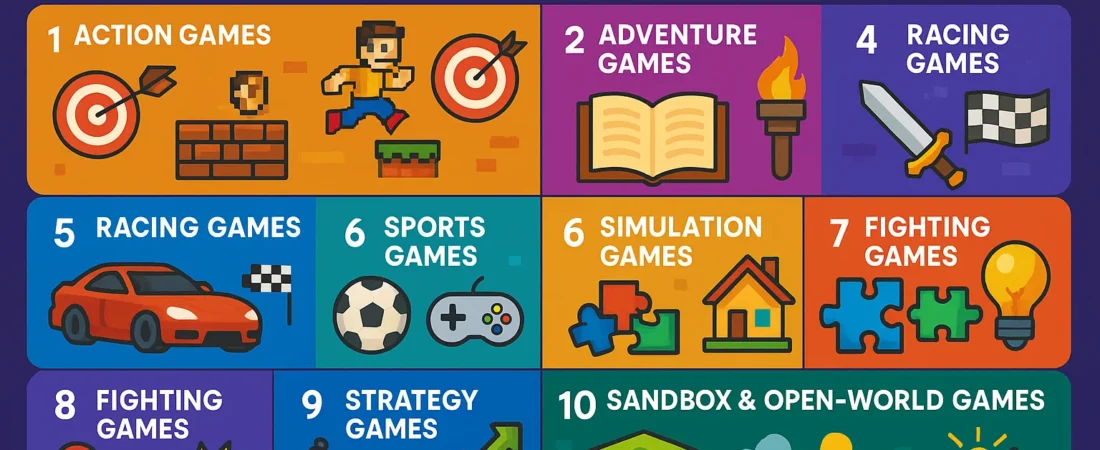
Video games are played using devices such as computers, consoles, smartphones, and handheld systems. They include many genres, including action, adventure, role-playing, racing, sports, simulation, puzzle, and strategy.
Different genres provide different experiences. An adventure game may emphasize exploration and storytelling, while a strategy title can require planning several moves ahead. Multiplayer games can add cooperation or competition between players.
Because digital games combine technology with interactive systems, they can offer experiences that would be difficult to reproduce through traditional play.
Board and Card Games
Board games and card games remain popular because they encourage direct interaction between players. Chess, checkers, traditional card games, and modern tabletop games can involve strategy, planning, negotiation, memory, or chance.
They can also be particularly useful for social gatherings. A family game night, for example, does not require expensive hardware or an internet connection. Players can sit together, learn the rules, and participate in the same activity.
Modern tabletop gaming also includes cooperative games, party games, role-playing systems, and strategy-focused experiences, creating options for different group sizes and interests.
Outdoor and Sports Games
Outdoor games combine play with physical movement. Football, cricket, basketball, badminton, and many other sports involve rules, objectives, teamwork, and competition.
These activities offer a different experience from screen-based entertainment because participants are physically active. Team sports can also develop communication and cooperation while creating opportunities for social interaction.
For people who spend much of their day sitting, incorporating physical games into leisure time can provide a useful change of pace.
Puzzle and Mental Games
Puzzle games challenge players to identify patterns, solve problems, remember information, or develop logical solutions. They can appear in physical formats, mobile apps, computer games, or tabletop products.
Examples include crosswords, Sudoku, logic puzzles, matching games, and strategy challenges. Their appeal often comes from the satisfaction of solving a difficult problem.
Research on gaming has examined cognitive and motivational aspects of play, although the benefits can vary considerably according to the type of game and how it is used.
Why Do People Play Games?
People play for many different reasons. Entertainment is an obvious one, but it is not the only motivation.
Some players enjoy competition and want to improve their performance. Others prefer exploration, storytelling, creativity, or social interaction. A game can also provide a temporary break from routine activities.
Research examining why people use games has found that enjoyment and perceived usefulness can both influence participation, depending on the type and purpose of the game.
For example, one person might choose a competitive multiplayer game because they enjoy teamwork, while another might select a relaxing puzzle game because they prefer quiet individual challenges.
Potential Benefits of Playing Games
Problem-Solving and Strategic Thinking
Many games require players to evaluate situations, identify possible solutions, and make decisions. Strategy and puzzle games can be especially demanding because success often depends on planning and adapting.
The value is not automatic, however. A game’s design, difficulty, and the way it is played all matter.
Social Connection
Games can bring people together. Board games encourage face-to-face interaction, sports create team environments, and online multiplayer games allow players to cooperate or compete remotely.
Cooperative play can be particularly engaging because participants must communicate and work toward a shared objective.
Creativity and Exploration
Some games give players freedom to experiment, construct environments, develop characters, or make meaningful choices. This can make gaming feel less like following a fixed sequence and more like exploring a system.
Video games, in particular, can provide interactive worlds where players discover locations, stories, mechanics, and challenges at their own pace.
Learning Opportunities
Games can also be designed for education and training. Educational games use interactive challenges to teach concepts, practice skills, or encourage learners to engage with difficult material. Serious games are specifically developed for purposes beyond straightforward entertainment, including learning and training.
This does not mean every game is educational. Rather, it shows that game-based interaction can serve different purposes when the design supports them.
How to Choose the Right Game
Choosing among thousands of possibilities can be easier when you start with your purpose.
| What You Want | Game Types to Consider |
|---|---|
| Quick entertainment | Casual, puzzle, card |
| Social interaction | Party, multiplayer, board |
| Physical activity | Sports, outdoor games |
| Strategic challenge | Strategy, chess, tactics |
| Story and exploration | Adventure, RPG |
| Creative freedom | Sandbox, building |
| Learning practice | Educational and serious games |
Think about time commitment as well. A short puzzle may suit a busy schedule better than a game that requires long sessions.
You should also consider the number of players. If you usually play alone, single-player adventures, puzzles, and strategy games may be appropriate. If you regularly play with family or friends, cooperative board games, party games, sports, or multiplayer titles may be better choices.
Age suitability, accessibility, device requirements, cost, and difficulty are other practical considerations.
How to Keep Gaming Balanced
Games are most useful as one part of a balanced routine. Players should consider their responsibilities, sleep, physical activity, social life, and other interests when deciding how much time to spend playing.
For digital games, taking regular breaks can make longer sessions more comfortable. It is also worth checking age ratings and content information when selecting games for children or younger players.
The goal is not necessarily to avoid gaming but to make sure it fits comfortably alongside other important activities.
The Future of Games
The gaming landscape continues to expand across physical and digital formats. Traditional board games remain relevant while digital platforms offer increasingly varied experiences. Hybrid games can combine physical components with software, while educational and training applications demonstrate how interactive play can be used outside conventional entertainment.
One important trend is the blending of genres. A single game may include role-playing elements, strategy systems, exploration, puzzles, and multiplayer features. This makes traditional categories useful for understanding games but not always sufficient for describing modern experiences.
Ultimately, this variety gives players more freedom to find experiences that match their preferences.
Read More: Khelosuper: Games, Login, Bonuses & Guide
Conclusion
Games are much more than a single form of entertainment. They include sports, board games, card games, puzzles, tabletop adventures, mobile experiences, and large digital worlds. Each category offers different ways to play, compete, cooperate, learn, or simply relax.
The best game depends on the person and the situation. Consider what you want from the experience, how much time you have, whether you prefer playing alone or with others, and what type of challenge interests you. With such a broad range of choices available, there is almost always a game that can match a particular mood, goal, or group.
FAQs
What are the main types of games?
Major categories include video games, board games, card games, sports, outdoor games, puzzles, tabletop role-playing games, and educational games. Many modern titles combine elements from several categories.
Are games only meant for entertainment?
No. Games can also support learning, training, social interaction, physical activity, problem-solving, and other purposes. Their purpose depends on how they are designed and used.
Which games are good for playing with friends?
Party games, board games, cooperative tabletop games, multiplayer video games, and team sports are all options. The best choice depends on the group’s size and preferred style.
Are puzzle games useful?
Puzzle games can provide opportunities to practice reasoning, pattern recognition, memory, and problem-solving. However, the specific experience varies from one game to another.
How do I choose a game for a child?
Consider the child’s age, interests, ability level, content, required equipment, and whether the game encourages an appropriate level of interaction. Checking the game’s age rating and content information can also help.
Can games be educational?
Yes. Educational and serious games can be deliberately designed around learning or training objectives. Some entertainment-focused games may also encourage skills such as planning, communication, or problem-solving, depending on their design.